


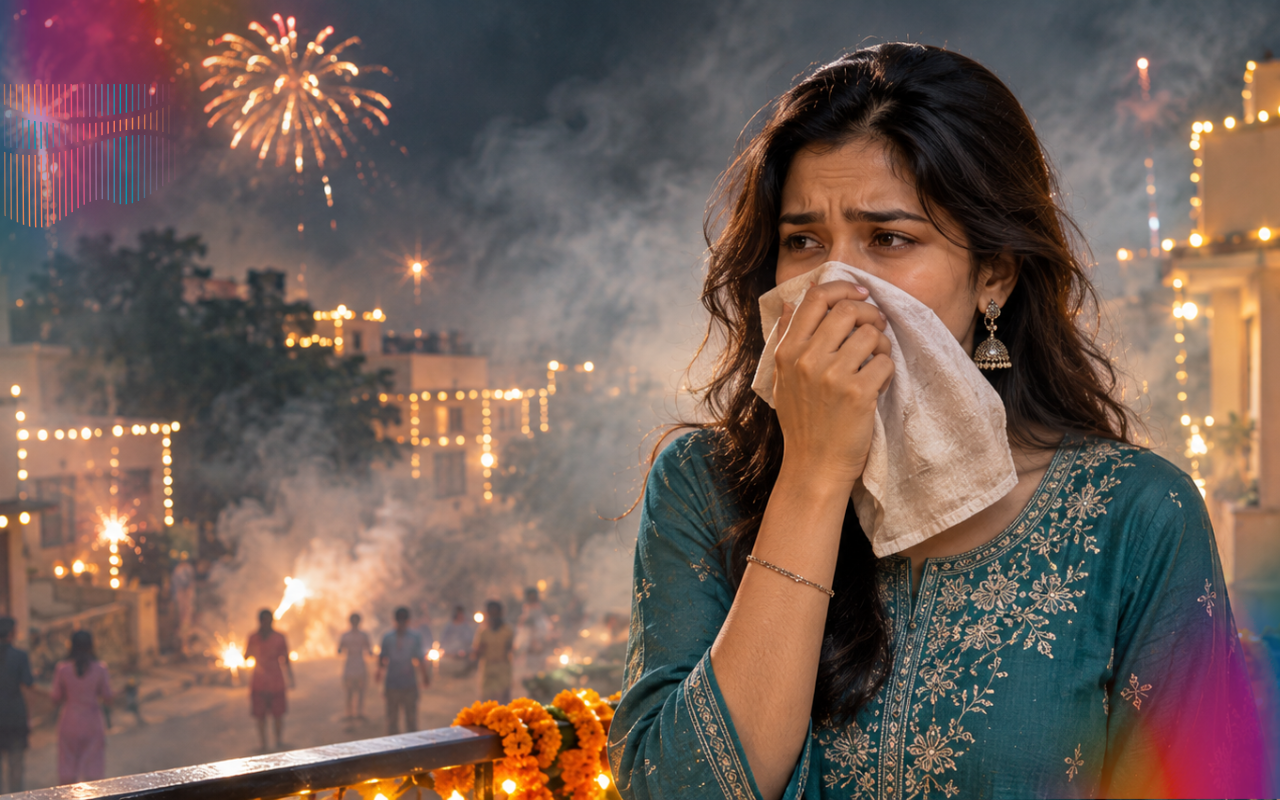

Diwali is that time of the year when homes sparkle, sweets disappear faster than we can keep track of, and the neighbourhood suddenly sounds like a celebration straight out of a Bollywood movie. But once the fireworks are over, there's often another side to the festivities: smoky skies, burning eyes, persistent coughing and that unmistakable haze hanging in the air.
Remember those dramatic Bollywood scenes where someone walks through a cloud of smoke, looking absolutely unbothered? Well, real-life smoke isn't nearly as cinematic. And when it comes to firecracker pollution, our lungs, heart and eyes may be paying a much bigger price than we realise.
So, what exactly happens to our bodies after a night of fireworks?
1. Your lungs: The first to feel the impact
Ever stepped outside the morning after Diwali and immediately felt like coughing? That's not just an unpleasant smell lingering in the air.
Firecrackers release fine particulate matter, particularly PM2.5, along with gases such as sulphur dioxide and nitrogen dioxide. These tiny particles can travel deep into the respiratory system, irritating the airways and triggering inflammation.
The result? Coughing, wheezing, throat irritation, breathlessness and worsening asthma symptoms.
For someone already living with asthma, chronic obstructive pulmonary disease (COPD) or another respiratory condition, even a short period of intense exposure can be particularly uncomfortable.
And here's something important: you don't have to be standing next to a firecracker to be affected. Fine particles can remain suspended in the air and travel beyond the immediate area where fireworks were burst.
The World Health Organization (WHO) has repeatedly highlighted how air pollution contributes to respiratory diseases, including asthma, chronic lung disease and lung cancer. Fine particulate pollution is particularly concerning because it can penetrate deep into the lungs and, in some cases, enter the bloodstream.
2. Your heart: The connection you probably didn't expect
We usually associate pollution with coughing or breathing difficulties. But did you know that polluted air can also affect your heart?
When fine particles enter the bloodstream or trigger inflammation in the body, they can affect blood vessels, circulation and the cardiovascular system. Exposure to particulate pollution has been associated with an increased risk of heart attacks, irregular heart rhythms and strokes.
This is particularly concerning for older adults and people with existing heart disease, high blood pressure or diabetes.
Think of it this way: your heart doesn't get a holiday just because you're celebrating one. If your body is dealing with polluted air, your cardiovascular system may also be under stress.
The US Environmental Protection Agency (EPA) identifies particle pollution as a risk factor for cardiovascular problems, including nonfatal heart attacks and irregular heartbeats.
3. Your eyes: Why do they burn after Diwali?
If you've ever rubbed your eyes repeatedly after watching fireworks, you've probably experienced one of the most immediate effects of firecracker pollution.
Smoke, dust and chemical irritants can disturb the delicate surface of your eyes, causing redness, watering, itching, burning and discomfort.
People with sensitive eyes, contact lens users and those already experiencing dry eyes may find these symptoms especially bothersome.
And no, rubbing your eyes aggressively isn't going to help. It can make irritation worse.
If your eyes feel irritated, rinse them gently with clean water, avoid rubbing them and seek medical advice if symptoms persist, become severe or include pain or blurred vision.
The National Centre for Disease Control's air-pollution health handbook lists eye redness and irritation among the short-term effects of exposure to polluted air.
4. The morning-after reality: Delhi's Diwali pollution
Let's look at a real-world example.
In October 2025, Delhi experienced a sharp deterioration in air quality following Diwali celebrations. According to The Indian Express, the city's AQI reached around 345 on Diwali, while particulate concentrations at several monitoring stations rose dramatically during the night.
The situation was a reminder that firecracker emissions can intensify an already polluted atmosphere, especially when weather conditions prevent pollutants from dispersing.
And this isn't simply a Delhi problem. Across several cities in northern India, stagnant post-monsoon weather and low winds can allow pollution to linger long after the celebrations end.
Think of it as the unwanted sequel to Diwali night: the fireworks are gone, but the smoke hasn't necessarily left.
5. Who should be extra careful?
While air pollution can affect everyone, some people are particularly vulnerable:
- Children, whose lungs are still developing.
- Older adults, especially those with existing health conditions.
- People with asthma, COPD or other respiratory illnesses.
- Individuals with heart disease, hypertension or diabetes.
- Pregnant women, who should take particular care to reduce exposure.
This doesn't mean everyone else is immune. Healthy adults can also experience irritation, coughing and breathing discomfort after exposure to polluted air.
6. Can you actually protect yourself after Diwali?
You cannot completely eliminate exposure when the air around you is polluted, but a few sensible precautions can help reduce it.
Check the AQI: Before stepping outdoors, check the local Air Quality Index. If pollution levels are high, avoid unnecessary outdoor activities.
Choose indoor activities: Skip outdoor workouts, jogging and long walks when air quality is poor.
Use a well-fitting N95 respirator: It can help reduce exposure to airborne particles when worn correctly. Ordinary cloth masks offer much less protection against fine particulate matter.
Keep indoor air cleaner: Close windows during periods of heavy outdoor pollution, and consider a suitable air purifier if available.
Don't ignore symptoms: Persistent coughing, wheezing, breathlessness, chest discomfort or severe eye irritation deserve medical attention. Chest pain, severe breathing difficulty or sudden vision changes require urgent medical care.
These precautions are especially important for people with existing respiratory or cardiovascular conditions.
Let the lights shine, not the lungs suffer
Diwali is about happiness, togetherness, traditions and memories that stay with us long after the festival ends. And honestly, a celebration that leaves everyone struggling to breathe isn't quite the celebration we want.
The good news? Enjoying Diwali and caring for your health don't have to be competing priorities. Choosing quieter celebrations, reducing firecracker use, protecting vulnerable family members and paying attention to air quality are meaningful ways to make festivities more considerate.
After all, the best Diwali memories are the ones we can enjoy without spending the next morning coughing our way through them.
Want to make everyday health awareness a little easier? Download the Zyephr app and explore its health and wellness content, useful everyday health information and tools to keep track of your health-related routines. A little awareness can go a long way in making informed choices about your wellbeing.



 admin@zyephr.com


