


Have you ever felt a "phantom vibration" in your pocket, reached for your phone, and realized no one actually messaged you?
That strange, twitchy sensation is more than just a bad habit—it’s a sign that your brain has been physically remapped. Social media platforms are designed by "attention architects" to keep your brain in a loop of constant anticipation. When you decide to quit, or even just take a long break, you aren’t just "getting your time back." You are essentially putting your brain into a state of neurological renovation.
Here is the deep dive into what happens inside your head when you finally break the cycle, backed by the latest neuroscience studies.
The Dopamine "Cool Down"
Our brains love a surprise. Every time you pull down to refresh your feed, you’re pulling a digital slot machine. This triggers a hit of dopamine, the neurotransmitter responsible for "wanting" and "seeking." In her book Dopamine Nation, Dr. Anna Lembke explains how this constant stimulation creates a "pleasure-pain balance" that leaves us feeling empty when we aren't scrolling.
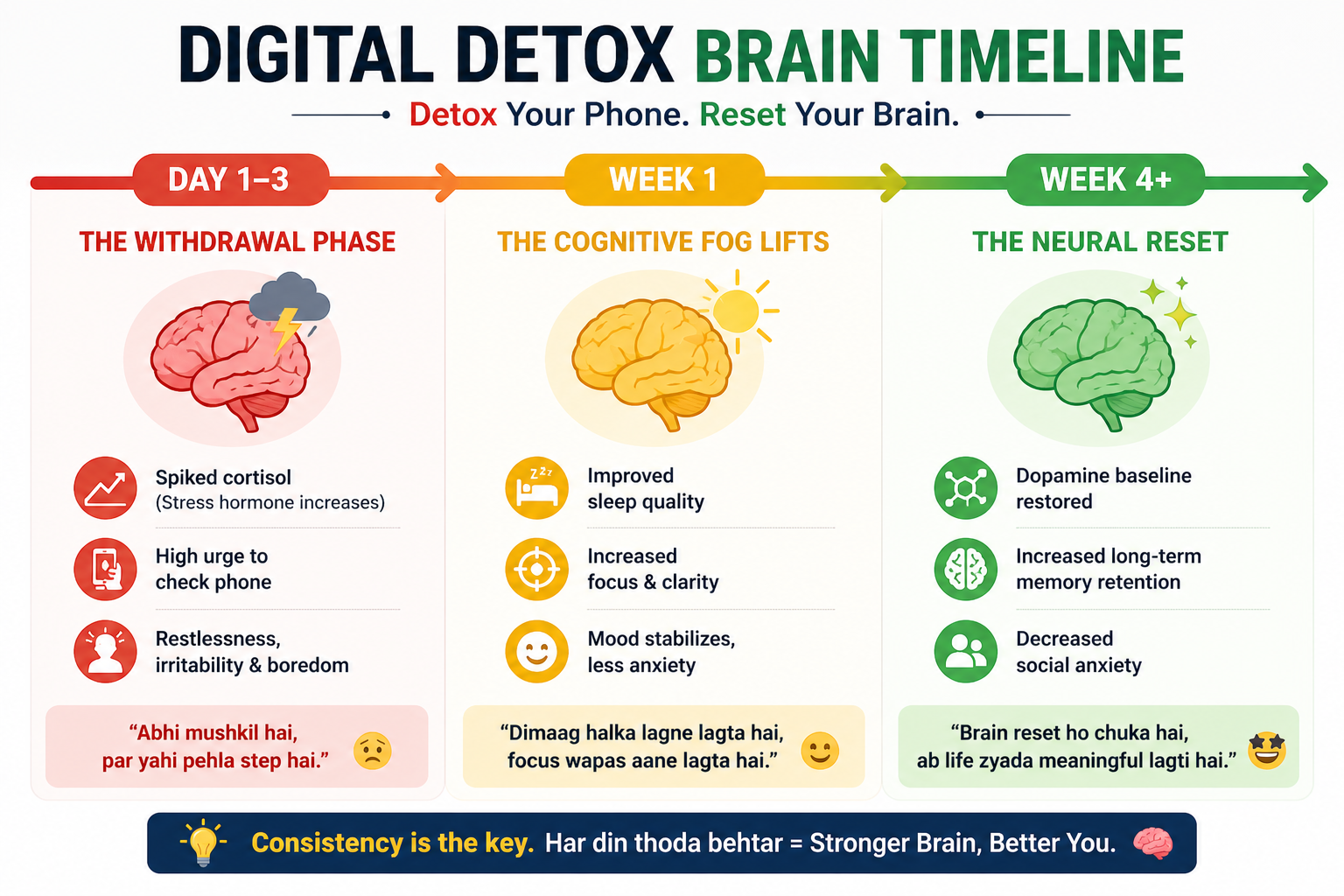
When you quit, the "slot machine" disappears. For the first 48 to 72 hours, you will likely feel irritable, restless, or bored. This is a physiological withdrawal. However, your brain’s reward system eventually recalibrates. Your baseline dopamine levels stabilize, meaning you’ll find it easier to enjoy "low-stimulus" activities—like a quiet walk or a long-form conversation—without feeling the frantic need for a digital hit.
Silencing the Cortisol Alarm
Social media often keeps us in a state of "passive threat detection." Whether it’s an aggressive comment section, a polarizing news headline, or the subtle sting of social exclusion, your amygdala (the brain’s fear center) stays on high alert, pumping out cortisol, the primary stress hormone.
The physiological impact is measurable; a landmark study from the University of Queensland found that taking just a five-day break from Facebook significantly lowered the levels of cortisol in the body. By quitting, you’re effectively telling your nervous system it’s finally safe to stand down from a "fight or flight" state you didn't even realize you were in.
Rebuilding the "Focus Muscle"
Social media rewards "rapid-fire" attention—scrolling through twenty different emotions and topics in sixty seconds. This process fragments our prefrontal cortex, the part of the brain that handles complex problem-solving, deep work, and impulse control.
Research published in Nature Communications suggests our collective attention spans are shrinking due to this constant information overload. Think of quitting as a gym workout for your concentration. When you stop the "micro-switching" habit, your brain begins to strengthen its executive function. Within two weeks, users often report that "brain fog" lifts. You’ll find you can stay on a single task—like writing a report or finishing a chapter of a book—for 40 minutes instead of four.
The Sleep Architecture Reset
It’s a double whammy: the blue light from your screen suppresses melatonin (the sleep hormone), and the emotional content (like a stressful tweet) keeps your brain in an "active" beta-wave state. Harvard Health notes that blue light has a dark side, specifically disrupting our circadian rhythms more than any other wavelength.
By removing the "bedtime scroll," you allow your brain to transition into the Alpha and Theta wave states necessary for restorative sleep. This leads to better REM (Rapid Eye Movement) cycles, which is the crucial window when your brain "cleans out" metabolic toxins and processes the day's emotions.
Shrinking the "Comparison Loop"
Humans are hardwired for social comparison, but we aren't wired to compare our "behind-the-scenes" with the "highlight reels" of thousands of strangers. This constant comparison overstimulates the lateral prefrontal cortex, often leading to feelings of inadequacy. A study in the Journal of Social and Clinical Psychology found that limiting social media use significantly reduces feelings of loneliness and depression. Quitting breaks this loop, allowing your self-perception to return to a more grounded, internal reality.
Ultimately, quitting social media isn’t about deleting an app; it’s about reclaiming the biological sovereignty of your brain. By stepping away from the "infinite scroll," you allow your nervous system to exit a state of constant high alert and give your dopamine receptors the chance to appreciate the richness of the real world again. While the initial "neurological renovation" can feel uncomfortable—marked by boredom or restlessness—the reward is a mind that is sharper, calmer, and more present. Whether you choose a permanent exit or a structured digital detox, you are giving your brain the space it needs to focus on what truly matters: deep work, genuine connection, and restorative rest.



 admin@zyephr.com


